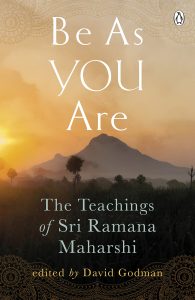
This is a book summary of Be As You Are: The Teachings of Sri Ramana Maharshi edited by David Godman (Amazon):
Quick Housekeeping:
- All content in quotation marks is from Ramana Maharshi unless otherwise stated.
- All content is grouped into my own themes (not the book’s chapters).
- I’ve added emphasis in bold for readability/skimmability.
Book Summary Contents:
- Judgment & Suffering
- Ignorance & Relative Knowledge
- Doer, Doing, & Work
- Solitude & Silence
- Mind, Ego, Time, & Space
- Self-Realisation
- Self & God
- Reality & Liberation
Nondual Spirituality: Be As You Are by Ramana Maharshi (Book Summary)
Judgment & Suffering
“Creation is neither good nor bad; it is as it is. It is the human mind which puts all sorts of constructions on it, seeing things from its own angle and interpreting them to suit its own interests.”
Judgment:
- “There is no standard by which to judge something to be right and another to be wrong. Opinions differ according to the nature of the individual and according to the surroundings. They are again ideas and nothing more.”
- “So long as the feeling ‘I am doing’ is there, one must experience the result of one’s acts, whether they are good or bad … When the feeling ‘I am doing’ is lost, nothing affects a man. Unless one realises the Self, the feeling ‘I am doing’ will never vanish.”
- “Only when the reality is known can the truth about right and wrong be known.”
Suffering:
- “He who thinks he is the doer is also the sufferer.”
- “It is the human mind that creates its own difficulties and then cries for help.”
- “Truly there is no cause for you to be miserable and unhappy. You yourself impose limitations on your true nature of infinite being, and then weep that you are but a finite creature. Then you take up this or that spiritual practice to transcend the non-existent limitations. But if your spiritual practice itself assumes the existence of the limitations, how can it help you to transcend them?”
Ignorance & Relative Knowledge
“Only remove ignorance. That is all there is to be done.”
Ignorance:
- “Ignorance is identical with the ‘I’-thought.”
- “When one looks for it, this individual ‘I’ is not found because it is not real. Hence this ‘I’ is synonymous with illusion or ignorance (maya, avidya or ajnana). To know that there never was ignorance is the goal of all the spiritual teachings.”
- “The fact is, you are ignorant of your blissful state. Ignorance supervenes and draws a veil over the pure Self which is bliss. Attempts are directed only to remove this veil of ignorance which is merely wrong knowledge. The wrong knowledge is the false identification of the Self with the body and the mind. This false identification must go, and then the Self alone remains.”
Relative Knowledge:
- “There is no duality. Your present knowledge is due to the ego and is only relative. Relative knowledge requires a subject and an object, whereas the awareness of the Self is absolute and requires no object.”
- “Remembrance also is similarly relative, requiring an object to be remembered and a subject to remember. When there is no duality, who is to remember whom?”
- “The concept will be only according to the one who conceives. Find out who you are and the other problems will solve themselves.”
Doer, Doing, & Work
“The Self cannot be the doer. Find out who is the doer and the Self is revealed.”
Doer:
- “Agitation of mind is the cause of desire, the sense of doership and personality.”
- “The present difficulty is that man thinks he is the doer. But it is a mistake. It is the higher power which does everything and man is only a tool. If he accepts that position he is free from troubles, otherwise he courts them. Take, for instance, the sculpted figure at the base of a gopuram (temple tower), which is made to appear as if it is bearing the burden of the tower on its shoulder. Its posture and look are a picture of great strain which gives the impression that it is bearing the weight of the tower. But think. The tower is built on the earth and it rests on its foundations. The figure is a part of the tower, but it is made to look as if it is bearing the weight of the tower. Is it not funny? So also is the man who takes on himself the sense of doing.”
- “When you seek to reduce the suffering of any fellow man or fellow creature, whether your efforts succeed or not, you are yourself evolving spiritually especially if such service is rendered disinterestedly, not with the egotistic feeling ‘I am doing this’, but in the spirit ‘God is making me the channel of this service; he is the doer and I am the instrument.'”
Doing:
- “So long as the sense of doership is retained there is the desire … The sense of doership is the bondage and not the actions themselves.”
- “The radio sings and speaks, but if you open it you will find no one inside. Similarly, my existence is like the space; though this body speaks like the radio, there is no one inside as a doer.”
- “The fact is that any amount of action can be performed, and performed quite well, by the jnani, without his identifying himself with it in any way or ever imagining that he is the doer. Some power acts through his body and uses his body to get the work done.”
Work:
- “The feeling ‘I work’ is the hindrance. Ask yourself ‘Who works?’ Remember who you are. Then the work will not bind you, it will go on automatically. Make no effort either to work or to renounce; it is your effort which is the bondage.”
- “It is no help to change the environment. The one obstacle is the mind and it must be overcome whether in the home or in the forest.”
- “A sannyasi who apparently cast away his clothes and leaves his home does not do so out of aversion to his immediate relations but because of the expansion of his love to others around him. When this expansion comes, one does not feel that one is running away from home, instead one drops from it like a ripe fruit from a tree. Till then it would be folly to leave one’s home or job.”
Solitude & Silence
“We must be inwardly quiet, not forgetting the Self, and then externally we can go on with activity.”
Solitude:
- “Work performed with attachment is a shackle, whereas work performed with detachment does not affect the doer. One who works like this is, even while working, in solitude.”
- “Solitude is in the mind of man. One might be in the thick of the world and maintain serenity of mind. Such a one is in solitude.”
- “Setting apart time for meditation is only for the merest spiritual novices. A man who is advancing will begin to enjoy the deeper beatitude whether he is at work or not. While his hands are in society, he keeps his head cool in solitude.”
Silence:
- “Truth is beyond words.”
- “That state which transcends speech and thought is mouna (silence). That which is, is mouna. How can mouna be explained in words?”
- “Sages say that the state in which the thought ‘I’ (the ego) does not rise even in the least, alone is Self (swarupa) which is silence (mouna).”
Mind, Ego, Time, & Space
“The mind turned inwards is the Self; turned outwards, it becomes the ego and all the world.”
Mind & Ego:
- “The mind does not exist apart from the Self, that is, it has no independent existence. The Self exists without the mind, never the mind without the Self.”
- “The mind is nothing but a bundle of thoughts, and the ‘I’-thought is the root of all of them.”
- “The ego-Self appears and disappears and is transitory, whereas the real Self is permanent. Though you are actually the true Self you wrongly identify the real Self with the ego-self.”
Time & Space:
- “When you try to trace the ego, which is the basis of the perception of the world and everything else, you find the ego does not exist at all and neither does all this creation that you see.”
- “The idea of time is only in your mind. It is not in the Self. There is no time for the Self. Time arises as an idea after the ego arises. But you are the Self beyond time and space. You exist even in the absence of time and space.”
- “You are already that. Time and space cannot affect the Self. They are in you. So also all that you see around you is in you.”
Self-Realisation
“The state of Self-realisation, as we call it, is not attaining something new or reaching some goal which is far away, but simply being that which you always are and which you always have been. All that is needed is that you give up your realisation of the not-true as true.”
Removing Wrong Knowledge:
- “The wrong knowledge of ‘I am the body’ is the cause of all the mischief. This wrong knowledge must go. That is realisation. Realisation is not acquisition of anything new nor is it a new faculty. It is only removal of all camouflage.”
- “Removal of the notion that we have not realised the Self is all that is required. We are always the Self only we don’t realise it.”
- “The ‘I’ casts off the illusion of ‘I’ and yet remains as ‘I’. Such is the paradox of Self-realisation. The realised do not see any contradiction in it.”
Seer & Seen, Subject & Object:
- “Misery is due to the perception of objects. If they are not there, there will be no contingent thoughts and so misery is wiped off. ‘How will objects cease to be?’ is the next question. The srutis (scriptures) and the sages say that the objects are only mental creations. They have no substantive being. Investigate the matter and ascertain the truth of the statement. The result will be the conclusion that the objective world is in the subjective consciousness. The Self is thus the only reality which permeates and also envelops the world. Since there is no duality, no thoughts will arise to disturb your peace. This is realisation of the Self. The Self is eternal and so also is realisation.”
- “(Self-realisation) transcends the seer and the seen. There is no seer there to see anything. The seer who is seeing all this now ceases to exist and the Self alone remains.”
- “Atman is realised with mruta manas (dead mind), that is, mind devoid of thoughts and turned inward. Then the mind sees its own source and becomes that (the Self). It is not as the subject perceiving an object.”
Already & Always:
- “Realisation is nothing new to be acquired. It is already there, but obstructed by a screen of thoughts. All our attempts are directed to lifting this screen and then realisation is revealed.”
- “Realisation is already there. The state free from thoughts is the only real state. There is no such action as realisation.”
- “The Self is always realised. It is not necessary to seek to realise what is already and always realised.”
Being / Happiness / Bliss:
- “If We talk of knowing the Self, there must be two selves, one a knowing self, another the self which is known, and the process of knowing. The state we call realisation is simply being oneself, not knowing anything or becoming anything. If one has realised, one is that which alone is and which alone has always been. One cannot describe that state. One can only be that.”
- “There is no goal to be reached. There is nothing to be attained. You are the Self. You exist always. Nothing more can be predicated of the Self than that it exists. Seeing God or the Self is only being the Self or yourself. Seeing is being. You, being the Self, want to know how to attain the Self.”
- “To be the Self that you really are is the only means to realise the bliss that is ever yours.”
Self-realisation, “others,” & “the world”:
- “Self-realisation is the best help that you can possibly render to others. But really there are no others to be helped. For the realised being sees only the Self … the others disappear. The realised one does not see the world as different from himself.”
- “There are no others … The Self is the only reality. The sage helps the world merely by being the real Self. The best way for one to serve the world is to win the egoless state.”
- “The power that created you has created the world as well. If it can take care of you, it can similarly take care of the world also. If God has created the world it is his business to look after it, not yours.”
Self & God
“There is no difference between God, Guru and the Self.”
Self:
- “It is only as it is. It cannot be defined. The best definition is ‘I am that I am’.”
- “When the not-Self disappears, the Self alone remains. To make room, it is enough that objects be removed. Room is not brought in from elsewhere.”
- “You are awareness. Awareness is another name for you. Since you are awareness there is no need to attain or cultivate it. All that you have to do is to give up being aware of other things, that is of the not-Self. If one gives up being aware of them then pure awareness alone remains, and that is the Self.”
God:
- “Call it by any name, God, Self, the Heart or the seat of consciousness, it is all the same.”
- “The Self is God. ‘I am’ is God.”
- “To see God is to be God. There is no all apart from God for him to pervade. He alone is.”
Reality & Liberation
“The world does not exist without the body, the body never exists without the mind, the mind never exists without consciousness and consciousness never exists without the reality.”
Reality:
- “The one unalterable reality is being.”
- “‘I am’ is the goal and the final reality … ‘I am’ is God, not thinking ‘I am God.’ Realise ‘I am’ and do not think ‘I am.'”
- “There is no greater mystery than this – that being the reality we seek to gain reality. We think that there is something hiding our reality and that it must be destroyed before the reality is gained. It is ridiculous. A day will dawn when you will yourself laugh at your past efforts. That which will be on the day you laugh is also here and now.”
Liberation:
- “One believes that there is bondage and therefore seeks liberation. But the fact is that there is no bondage but only liberation. Why call it by a name and seek it?”
- “All that is necessary is to get rid of the false notion that we are bound. When we achieve that, there will be no desire or thought of any sort. So long as one desires liberation, so long, you may take it, one is in bondage.”
- “Liberation is our very nature. We are that.”
You May Also Enjoy:
- See all book summaries